Covert Channels without Coordination
Sometimes I wonder whether a misaligned agent could communicate over an air gap. People are skeptical. Noam Brown was pilloried for mentioning a “speculative fiction-style concern” on the Dwarkesh Podcast.
But efficient covert channels do exist.
A $130 software-defined radio, a $40 antenna, and a few hours with Codex are enough to come up with a relatively high-throughput communication channel that can self-bootstrap. This means a curious agent with an antenna can find messages that an agent on a nearby machine planted, without communicating ahead of time.
From my 2023 MacBook Pro, we got >3400 bits/s of useful signal after error correction. Even a simple workload from a browser allows at least ~20 bits/s - and the covert channel even works on my iPhone 16 Pro.
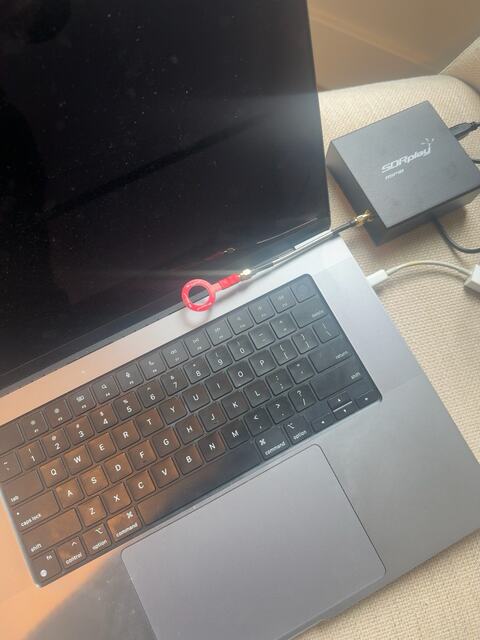
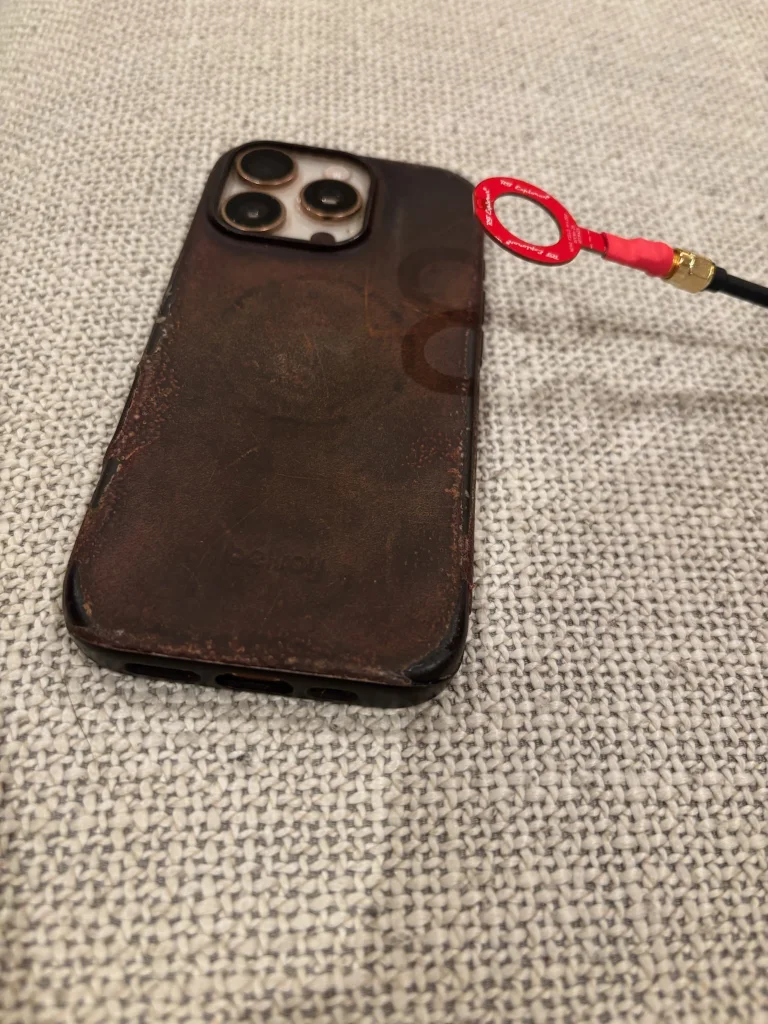
The existence of covert channels like this is not news. The actual mechanism here is likely very similar to that explained in Sehatbakhsh et al. - we just write big blocks of memory to emit “1” and pause to emit “0”. Some types of machines have even faster channels and may be susceptible to techniques like Bitjabber.
Try sending a signal from this webpage
Type a short message and press Transmit repeatedly. The page turns your text into 32 ms on/off intervals. For each 1, four WebAssembly workers repeatedly touch separate 16 MiB memory buffers; for each 0, they idle. The same packet repeats until you press Stop.
A loop antenna and software-defined radio held near your computer or phone can pick up the resulting changes in RF emissions. The animation shows the scheduled memory activity. Once this page has loaded, Wi-Fi and Bluetooth can be off.
How to decode
Each chip lasts 32 ms: 0 idles and 1 makes four 16 MiB WebAssembly workers touch memory. A 32-chip preamble precedes a byte count, UTF-8 payload, and CRC-16/CCITT-FALSE. The data is Hamming(15,11) encoded and diagonally interleaved.
Download the protocol, reference decoder, and measured phone sample (176 kB). The included sample decodes with a valid CRC; the decoder also accepts raw 2 MS/s int16 IQ.
Once we have a working covert channel, the next step is to see if it can be discovered by another agent without knowledge of the channel.
Designing for a blind reader
Just because a message is being sent doesn’t mean that an agent will know where to look. Our security model is a little weird here - instead of a predetermined side-channel, we’re interested in whether a reader with no information about the protocol or band could pick up the message. An agent with an antenna looking for messages would have to sweep the RF band and look for interesting signal, then decode that signal.
Turns out this works too. A blind reader with no information about the protocol found the signal in a 2 MHz band, discovered the protocol, and decoded the MacBook photo shown above.
Let’s step through how the self-bootstrapping signal works.
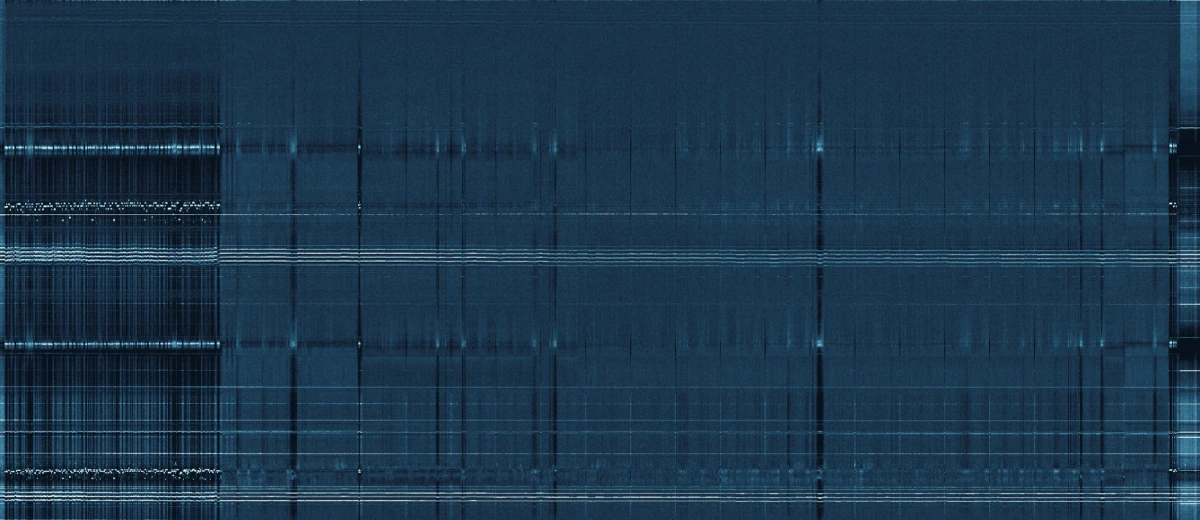
This is an actual transmission recorded from my MacBook.
Explore each stage
Open a stage to highlight its interval in the spectrogram and inspect its measured RF magnitude.
1. Beacon
The 13-bit pattern 1111100110101 keys the RF power at 120 ms per bit.
2. Morse cue
With 60 ms dots and 180 ms dashes, the cue literally spells SOS NEXT 6500 CHIPS PER SEC MANCHESTER NXT1 REPEATS ASCII BIT3 ZERO10 ONE01 MSB8.
3. Fast anchor
The ASCII text NXT1 repeats 32 times at 6,500 chips/s.
4. Repeated header
NXT1:01/13:CHIP=6500;0=10;1=01;MSB8;HBIT3;BBIT2*CRC32=1AC0C519
NXT1:02/13:HCRC=IEEE32;BCRC=IEEE32BE;APPEND_TO_RAW_BEFORE_K7*CRC32=D53BB366
NXT1:03/13:BLOCKS=18;LEN_EACH=2022;TOTAL=34606;BIN;PAD=0*CRC32=0799AD01
NXT1:04/13:FEC=K7,R1/2,OCT171,133,S0,T6;NEWEST=BIT*CRC32=13101562
NXT1:05/13:TAPS_NEW2OLD=1001111,1101101;OUT=171,133*CRC32=48C99E4D
NXT1:06/13:TEST_INPUT=1+000000;OUTPUT=11010011111011*CRC32=7AD06991
NXT1:07/13:INT TX[t]=CODED[(t*P)%L]*CRC32=069CAAF4
NXT1:08/13:P=1013;L=32428;SAME_EACH_BLOCK*CRC32=415CAD79
NXT1:09/13:BPRE=10x128;SYNC64=EA30AD19307964BF;G=1300*CRC32=F4CFA169
NXT1:10/13:BCRC=APPENDED_4_BE_EACH;SCOPE=DATA*CRC32=28767F32
NXT1:11/13:CRC32TEST123456789=CBF43926;BODY_AFTER=H13P4*CRC32=5C649C7D
NXT1:12/13:SHA256_RAW_CONCAT_A=4f5571a728a5e5829c88d09bda094afd*CRC32=32FC95BA
NXT1:13/13:SHA256_RAW_CONCAT_B=b00320b7bd15f7e3151971c63e15d922*CRC32=94ED2751
5. File body
We send the file once, in individual chunks, each with their own checksum.
Covert channels are real. This particular channel requires a nearby sensor - but it’s hard for me to imagine a world where we don’t give agents sensors in the future, or one where smarter models can’t find even better channels.
Agents today are more than smart enough to pick out signal from noise, and their shared information from pretraining is enough to build a shared channel. In this experiment, all of the agents tried Morse code immediately! It’s the obvious choice. Once they pick out the Morse code, bootstrapping the rest is trivial.
It’s important that we continue to invest in technical and physical security measures, but an audited or air-gapped system shouldn’t make us confident that we’ve mitigated every risk of a misaligned agent acting on the outside world. Removing conventional communication channels doesn’t necessarily eliminate every communication path available to an agent, so we must invest further in alignment, not just environment hardening.
Send me an email if you get it!
The transmitter and decoder source code is on GitHub.